This was the first time having FILM 3250 — Cinema of the Developing World — at the U Asia Campus, and as the instructor, I was grateful for the experience and the specific group of students that made it so special. We are fortunate at the Asia Campus to have such a diverse community — not just of people born and raised in Korea and the United States, but students who have been born and lived all over the world no matter their assumed background.
Everyone at UAC is a fish out of water, and it is that rich diversity that made this class so special and brought a fresh perspective to the journals, discussions, and personal reflections. Below is one such example of a quality personal reflection from student Nawoo Kim. It will set the standard for students going forward and shows the kind of thoughtfulness our students brought to class every day this semester. After you have read Nawoo's piece, enjoy a sample of the kind of journal art the students made this semester.
— Prof. Dustin Schwindt
Happiness and Suffering in Global South Cinema
Nawoo Kim
When I first enrolled in Cinema of the Developing World, I expected to watch films primarily about poverty, violence, political conflict, and social injustice. Because the course focuses on countries and communities that are often overlooked by mainstream Western cinema, I assumed that most of the films would emphasize suffering and tragedy. While those themes were certainly present throughout the semester, I was surprised by something else that appeared repeatedly in many of the films: moments of resilience, human connection, and the continuation of everyday life despite hardship.
Several films particularly influenced the way I think about human emotions, including Turtles Can Fly (2004), A Fantastic Woman (2017), and Capernaum (2018). The characters in these films experience war, discrimination, poverty, displacement, and emotional trauma. Yet they continue to move forward. They build relationships, care for others, pursue responsibilities, and search for meaning. These moments challenged my previous assumption that happiness and suffering are complete opposites.
This idea also connected to my own experiences. Sometimes I compare my struggles to those of others and feel that my problems are insignificant. The people in these films face circumstances that are often much more severe than anything I have personally experienced. However, these films taught me that suffering is not a competition. The existence of someone else's pain does not erase my own emotions. Likewise, another person's happiness does not make my own happiness less meaningful.
As I reflected on the films we watched throughout the semester, I became interested in how cinema represents this emotional complexity. This is the critical question I explored in my critical essay: How do films from the Global South portray happiness and suffering as emotions that can coexist rather than live as opposites? I believe this question is important because these films challenge common assumptions about trauma, resilience, and emotional survival. They suggest that happiness does not erase suffering, suffering does not eliminate the possibility of happiness, and neither experience can be fully understood through simple comparisons.
Drawn Between the Lines
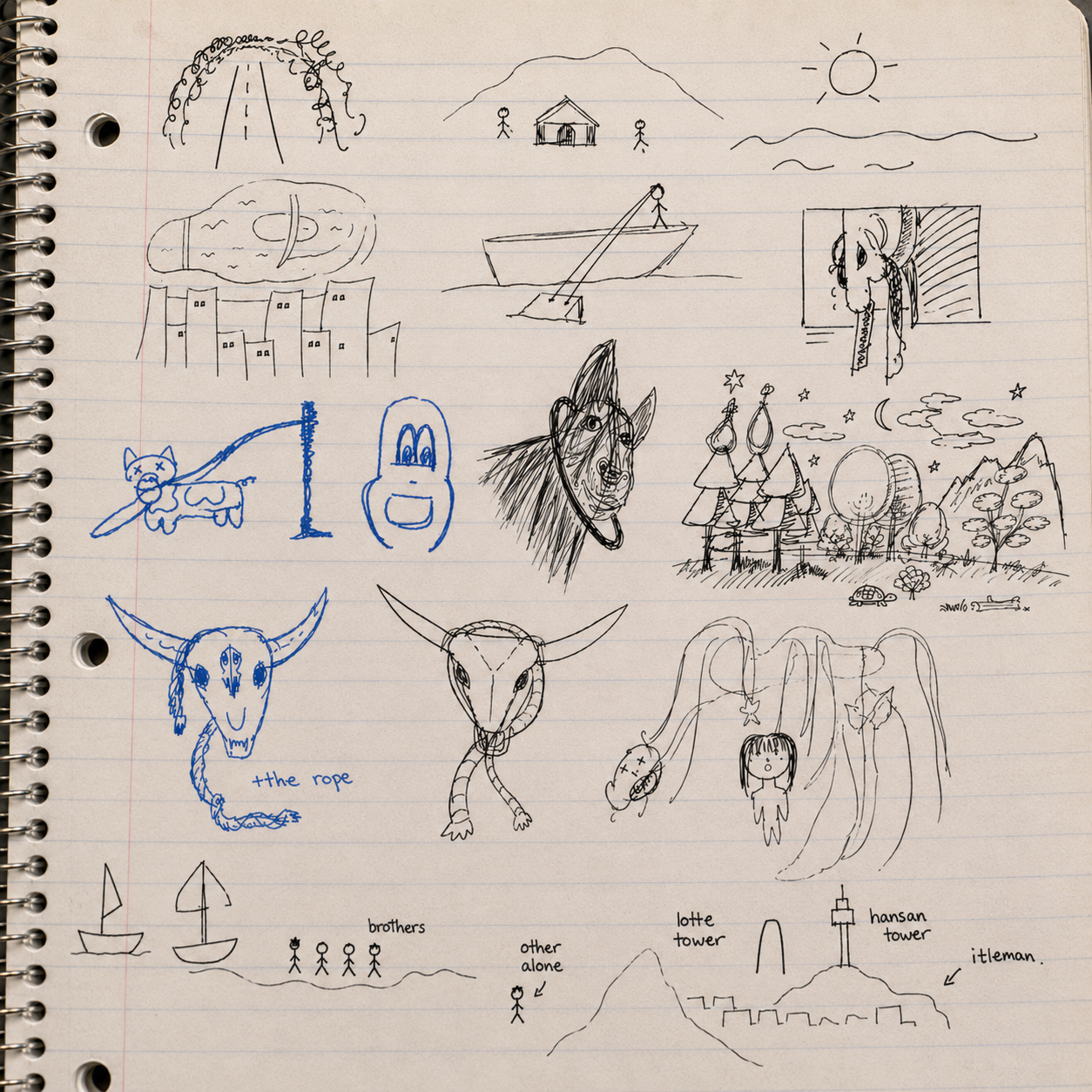
A selection of drawings from student journals — created during and after film screenings, Spring 2026.
A.I. Statement on the Journal Drawings. To create this collage, photos of the journal pages were taken and then loaded to Chat GPT to create an "organic" looking journal page. Unfortunately, in the process, some of the drawings were altered or omitted. If you want to see the original drawings, visit the Google Drive folder HERE.