Moolaadé takes place as a village story, functioning like a small society with its own distinct rules. It's a powerful film because it shows people coming together through group tension and discussion, utilizing a highly collective approach. Additionally, the "griot" style of storytelling in Moolaadé can be seen through each character's histories, anxieties, and thoughts that they share altogether.
The conflicts in the narrative are mainly the women of the community versus the elders. The film chooses to focus deeply on the girls and the tradition of the practice of Female Genital Mutilation (FGM), telling the audience of its history, culture, heritage, and how the female and ancestors follow the tradition. By centering its main narrative focus on FGM, the film emphasizes the issue as something not just threatening individual women, but as systemic violence toward women. Ultimately, this collective approach shows that FGM cannot be fixed or eliminated easily without society itself noticing and rebelling against it.
(Gahyun, Maya, Haeun, Jiyoung, Zane, Nawoo, Sinbi, Yuna, Crist)
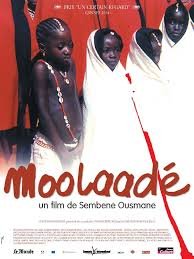
Theatrical poster
"Moolaadé takes place more as a village story, like a small society with its own rules."
— Haeun Cho
"The collective approach in Moolaadé shows that FGM cannot be fixed or eliminated easily without society itself noticing and rebelling against it."
— Yuna Lee
A note on this essay: The collective response above was assembled from individual student journal entries written immediately after the screening. Entries were compiled and edited using AI to eliminate repetition, preserve disagreement, and honor each student's voice — reducing the total word count by 75%. The writing remains the students' own.