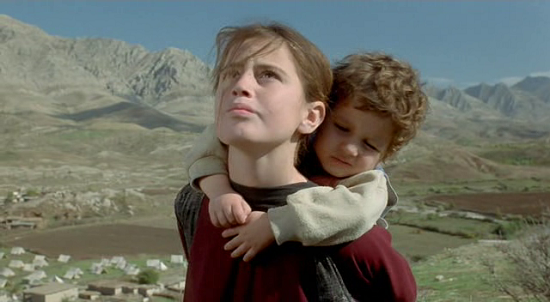
Turtles Can Fly shows the absurdity of war by using children as the primary characters. Kids are the ones responsible for clearing mines and reporting news to the older villagers. This whole situation shows how war is haunting nonsense and how violence persists even when there is no active shooting or bombing. Children who are meant to be pure act like grownups, yet it is still visible how young they think and act. The hardships they endure symbolize the death of youth.
Instead of going to school, they make money by collecting and selling parts from landmines. The kids working on minefields and buying guns is a harrowing reality portrayed in the film. The gun becomes a normal thing for them, even a toy. A kid teaching other kids how to shoot highlights how war severely affects children and destroys their lives. The children do not fully understand the conflict, but they still have to live in it and take on dangerous responsibilities. It is common to see children in this environment with severe physical disabilities, such as missing limbs. These images allow the audience to empathize with how easily innocent lives are affected by adult-driven conflict. The film delivers a strong message by portraying the loss of a normal childhood rather than only focusing on direct combat.
Specific moments and images stayed with us as viewers. One of the most haunting images was the armless boy extracting a mine from the ground with his teeth. Another was a baby being left alone in a minefield, a terrifying moment to watch. The scene where a toddler throws two mini turtles into a muddy puddle, and how the turtle reappears later, symbolizes the loss of hope within the war experience.
Individual stories also stood out. The scene where Riga was tied to a tree highlighted the desperate choices characters like Agrin had to make to survive. The film portrays the deep psychological trauma and PTSD these children suffer, often leaving them looking empty and emotionally numb. It is very saddening to see a young person's life torn apart by such heavy burdens while trying to maintain some semblance of innocence.
Characters also change throughout the movie. Satellite initially admires America and its influence, leading the others with that knowledge. However, over the course of the film, his perspective shifts. When he finally interacts with the American troops and receives what he thought he wanted, he sees the truth of his situation and turns away, no longer admiring them. The final scenes, showing the divergence between the military and the children, highlight the tragedy of Satellite's life and his ultimate disillusionment.
(Maya, Hauen, Jiyoung, Zane, Joohee, Nawoo, Sally, Sinbi, Hojune, Soojin, Yoo, Yingyue, Jeonju, Michelle, Samuel)
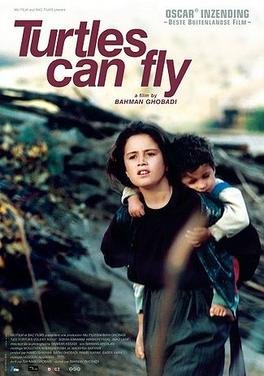
Theatrical poster
"The scene where the toddler throws two mini turtles into a muddy puddle and how the turtle reappears in the scene where Riga is drowned tells me the sunken hope within the war experience."
— Sinbi Kim
"In war films, showing violence is less impactful than showing the aftermath. Turtles Can Fly uses kids' view of what war is."
— Ho June Lee
A note on this essay: The collective response above was assembled from individual student journal entries written immediately after the screening. Entries were compiled and edited using AI to eliminate repetition, preserve disagreement, and honor each student's voice — reducing the total word count by 75%. The writing remains the students' own.
Turtles Can Fly — The Effects of War on Children's Innocence
A Video Essay created by Sally Kim, Sinbi Kim, and Crist Solidum