On Monday, May 18, FMA Alumnus Byungseok Kim visited the U Asia Campus for a special screening of Uncle Boonmee Who Can Recall His Past Lives. This is the text of his remarks before the film. Byungseok Kim, while a freshman at UAC, consulted on cultural nuances for language translation as then Professor Lee Isaac Chung revised his script for his film Minari. Subsequently, Byungseok's film "Swerve Confrontation" won the Jury Prize at the 2023 F&MAD Film Festival. He also lectured as a short-term visiting faculty at UAC for Prof. Simon McEnteggart's courses in Film History and Korean Cinema.
Byungseok Kim
FMA Alumnus, University of Utah Asia Campus. Filmmaker. Jury Prize winner, F&MAD Film Festival 2023.
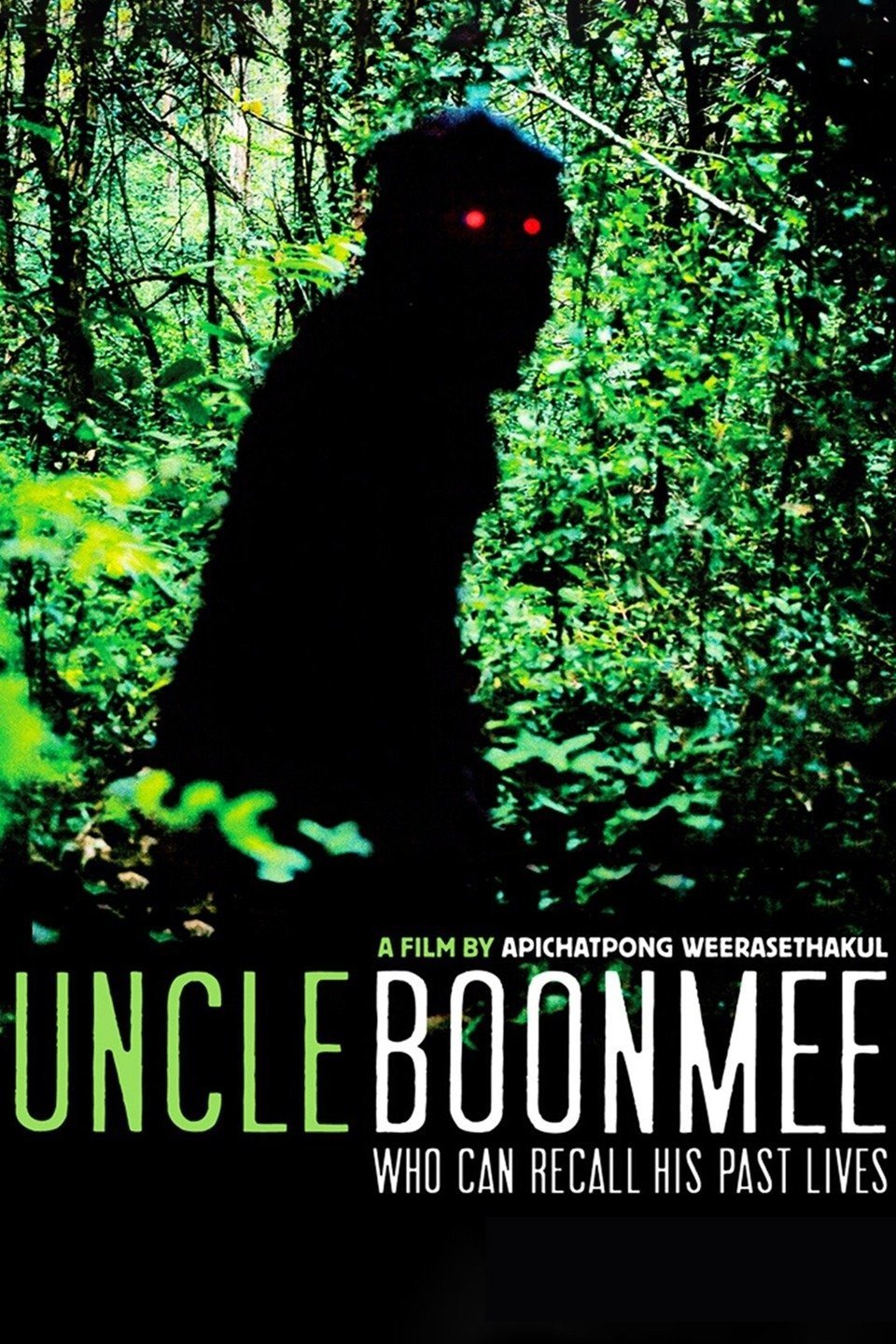
Theatrical poster
Delivered before the screening, Monday May 18, 2026
Before we dive into a discussion about the director, I want to start this talk with a more general question. What is a film? What is the role of cinema in this era of endless wars and tragedies, which do not wait for individuals to catch up? I often think about this when I write about films and especially when I make films by myself. At such times, I usually link films with rituals. Considering that a ritual utilizes physical symbols, such as totems or statues, as tangible evidence of invisible gods or spirits and as a channel to reach them, it resembles cinema, which uses fictional images to reveal the invisible layers of the world to its audience. Also, the performance of the medium in rituals, which is conducted to bridge the gap between spirits and the living people, has similarities with an actor's performance that guides audiences to the fictional characters by their bodies. Furthermore, considering that most rituals aim to offer proper room for giving unspoken words or prayers from survivors who have experienced the death of a loved one — and to let them visually acknowledge the absence so that they will live their own lives — we can notice that it is similar to cinematic representations that reconcile us with memories, such as historical tragedies, that have already concluded and been forgotten.
In this context, Thai filmmaker and artist Apichatpong Weerasethakul practices such a notion of cinema as ritual. On a superficial level, his films seem to simply deal with collective memory of historical tragedies like numerous directors already did. However, rather than forcing audiences to remember specific incidents through direct reenactments or the artificial construction of nostalgia, he tries to reveal that numerous unforgotten memories remain here and now through magical-realist and sometimes surrealist images. For example, highly fictional elements — such as the man-eating monster in The Mekong Hotel, deities and modern-day soldiers possessed by anonymous soldiers from an ancient kingdom in The Cemetery of Splendor, or the man-eating tiger in Tropical Malady — frequently appear in unexpected moments. Such beings, which are entities that have existed prior to the human characters in the films, work as a physical embodiment of unresolved emotions that have transformed their form into unfamiliar appearances over long periods of time. By giving the past physical forms which can influence the diegetic space-time of the film, Apichatpong tries to acknowledge that nothing has been forgotten and such things will remain by our side with various faces, now and ever. By doing so, he aims to leave room for collective memory and future discourse to form naturally.
Such a sense of the "persistent presence of being" is vital to fully experience Apichatpong's films. In all of his feature films, scenes from different time periods are juxtaposed randomly — and even merged into a single shot. In his films, time is a non-linear being and the past is not merely recollected. Instead, the process of accumulation and collision of the past slowly creates the present. These mingled timelines remind us of the French philosopher Henri Bergson's concept of durée, guiding audiences to realize that the present they are living is based on an ever-changing relationship between independent moments and memories. At the same time, the sudden and constant appearance of past scenes in Apichatpong's films calls to mind another French philosopher, Georges Didi-Huberman's, notion of fireflies. In his book The Survival of the Fireflies, Huberman uses the faint light emitted by fireflies as a metaphor for images and people against the system. The images of fireflies — which appear from time to time, vanish, and reappear to assert their existence in the vast dark of the night sky — work as a great framework to understand the mixed timelines of Apichatpong's films. Images that appear at unexpected moments, colliding with the space-time of the previous shot, try to prove their existence by demonstrating that they can still exert power over the narrative, and over the world. Their effect may be subtle, but it never disappears. These characteristics of fireflies give us a clue to perceive the fictional entities of his films as symbols of the dead during multiple massacres throughout the history of Thailand. They remain here, constantly casting their unfamiliar appearance, and because of that they cannot be forgotten easily. And — as if to prove this correlation — his 2021 short film Night Colonies sets flying insects of the night sky as its protagonists.
Going back to the original discussion: within such a framework of thought, the locations of his films become both political places full of unresolved resentment and the raw material for the aforementioned cinematic ritual. In the same book, Huberman states, "The reason fireflies vanish from [our] sight is that the place where [we] are standing is no longer a good place to find them." So, Apichatpong heads to the jungle. Most of his work takes place in the northeastern region of Thailand called Isan — a vast area of jungles and forests that extends right up to the borders with neighboring countries like Laos and Myanmar. Having evolved over years without human intervention, the forest's flora and fauna has become incredibly diverse. Because of such exotic features, the forest effectively works as a stage for cinematic ritual, letting audiences naturally embrace the fictional entities — monsters, tigers — who are living there. This aligns with the idea of the "cinematic forest" as "a network between humans, nonhumans, and other forces" and "the mythic past embedded in the site and the narratives produced by the filmmaker" — the notion in the article you have already read. At the same time, because this forest is so vast, it appears in almost every shot of most of Apichatpong's films as background. All the characters, and even the filmmaker himself, are hard-pressed to escape its influence. And because of that, the aforementioned sense of "persistent presence of being" is constantly highlighted naturally, even without the director's manipulation of time and space in post-production.
The most important point is that these jungles and forests preserve Thailand's historical tragedies themselves. The film Uncle Boonmee Who Can Recall His Past Lives, which you will see today, is set in the real village of Nabua in the Isan region. Nabua was one of the places the Thai army occupied from the 1960s to the early 1980s in order to suppress communist insurgents. Following a 1965 gun battle between communist farmers and the totalitarian government, Nabua was heavily occupied and controlled by the military. The locals were subjected to psychological and physical abuse on the grounds of withholding information. Women were raped. Some were murdered in their homes. Consequently, the villagers — mostly farmers — fled into the jungle. Most of them were not communists. In this context, the jungle itself becomes a historical scar that refuses to be forgotten. Anonymous emotions remain there, waiting to be excavated, waiting for their turn to raise voices once oppressed by the system. It becomes the purpose of the director's cinematic ritual. The traces of a forgotten past, scattered among the dense trees and vines, reach us through cinematic images. As such, historical context and aesthetic manipulation intertwine in the same location — the forest and the jungle — and the ritual starts.
At the same time, by actively incorporating self-reflexive elements in the filmmaking and image-making process, Apichatpong re-affirms that such a notion of film as ritual is art's response to the era. For example, Worldly Desire is filled with insert shots of a container truck full of C-stands and a music video set surrounded by filmmaking equipment, and in his short films The Phantoms of Nabua and Blue, the screen itself is presented as a key element of the mise-en-scène. In particular, the screen — which folds, flutters, and is even set on fire by the people and climate of its surrounding nature — directly reveals his attitude toward film. By reacting to the world, the screen and art create relationships between the world and themselves. By constantly constructing these meta-cinematic elements, the director expresses his commitment to image-making that can bridge forgotten fragments of the world and audience. In his same firefly book, Didi-Huberman states, "The firefly only seems to vanish as long as we give up chasing it." These meta-cinematic shots of Apichatpong Weerasethakul show his will to hold these fireflies — reminding audiences again and again of his artistic approach, which summons invisible memories flickering faintly like fireflies through fictional imagery.
Lastly, through his multimedia installations, Apichatpong represents this aesthetic purpose in more physical and direct form. In fact, Uncle Boonmee is part of an installation series exhibited alongside two other shorts — A Letter to Uncle Boonmee and the aforementioned The Phantoms of Nabua — that explore Nabua village in different contexts. By applying the "technical support" of multi-channel video installation and escaping from the conventional black-box space of movie theaters, memories in the images gain bodily presence in front of audiences, allowing them to indirectly sense the existence of memories that already exist right beside us. Furthermore, in recent years, Apichatpong has continued to create works such as interactive VR installations and non-video installations — including chandeliers with flickering LEDs that reflect the seismic activity of actual fault lines and volcanic belts of the earth. These works function as fictional symbols which mediate living people and the world, and become another version of the cinematic ritual we have discussed. His ritual is no longer confined to images on a screen. It is also taking place in the physical reality beneath our feet.
So, let's return to the first question. What is the role of cinema in the contemporary era? I hope you will find your own answers in the spirit-summoning performance led by the medium Apichatpong Weerasethakul.